

Published: | Updated: | Written by the Stoke Tuning team
If your Renault Trafic or Master has lit up an AdBlue warning light, you’re probably wondering whether you can still drive, how long you have before the van refuses to start, and what it actually costs to fix. This guide walks through exactly what’s happening, what fault codes mean, and what your real options are — from a proper OE repair to a software delete.
A Renault Trafic or Master AdBlue fault is usually caused by a failing SCR quality sensor, dosing pump fault, or NOx sensor — not simply low fluid. The van displays a kilometre countdown before locking out. Topping up fluid or clearing the code won’t fix a hardware fault. You need a proper diagnosis, an OE-spec part repair, or a permanent software delete.
The Warning Stages: What Each Message Means
The Renault Trafic III and Master III both use an EDC17-based SCR system that escalates through distinct warning stages when a fault is logged. Understanding which stage you’re at matters — it determines how urgently you need to act.
The amber AdBlue or emissions warning light appears on the dashboard. No countdown yet. You can still drive normally. This is the point to book a proper diagnosis — the sooner, the cheaper.
A message such as “Emissions fault: engine restart possible for 1,500 km” (or similar) appears. The van still drives and restarts, but each key cycle counts down. Don’t switch off the engine unnecessarily — every restart uses part of your remaining allowance.
Once the countdown expires, the ECU places a hard no-start restriction. This is not another warning — the van will not restart until the AdBlue system fault is resolved at source. A simple code clear will not lift this lockout.

The hard no-start lockout is an SCR compliance feature built into the van’s ECU calibration. It is not a mechanical failure of the engine itself — it is a software restriction that activates when the system determines the emissions control requirement can no longer be met.
Common Fault Codes and What They Mean
When a Renault Trafic or Master AdBlue system develops a fault, the ECU logs a diagnostic code. Here are the four codes seen most frequently on these vans:
| Code | Description | Likely cause |
|---|---|---|
| P207F | SCR NOx Catalyst Efficiency Below Threshold (Bank 1) | Diluted or wrong-spec AdBlue fluid; quality sensor fault; dosing injector not delivering correct volume |
| P204F | Reductant System Performance | Overall SCR system not reducing NOx to the required level; often a downstream symptom of pump, heater or sensor failure |
| P20E8 | Reductant Pump Performance | Dosing pump not building sufficient pressure; failing pump motor; blocked injector |
| P20EE | SCR NOx Catalyst Efficiency Below Threshold (Bank 1) | NOx sensor reading outside acceptable range; catalyst deterioration; sensor wiring fault |
It is worth noting that P204F often appears alongside one of the more specific codes above — it is a secondary, system-level fault that logs once the primary fault has triggered enough times to pull down overall SCR performance. Clearing P204F without fixing the root cause always results in it returning.
For context on how the UK’s SCR fault code landscape applies across diesel vehicles, the DVSA guidance on urea-based emissions systems sets out the compliance framework these systems are built to meet.
What Actually Causes AdBlue Faults on Trafic and Master Vans
Most Renault Trafic and Master owners assume the warning means they’ve run low on AdBlue. That’s the first thing to check — but in the majority of cases where the warning returns after a refill, or where a countdown has already started, the underlying issue is a component fault rather than fluid level.
SCR quality sensor failure
The quality sensor sits in the AdBlue tank and monitors fluid concentration. When it fails or reads outside its expected range, the ECU logs P207F and assumes the fluid is out of spec — even when it isn’t. Replacing the sensor with an OE-spec part and coding it to the vehicle is the correct fix. Generic aftermarket sensors often trigger the same code again within weeks.
AdBlue heater fault
AdBlue freezes at −11°C, so both the tank and supply line use an electric heater to prevent the fluid solidifying in cold weather. When the heater element or its wiring develops a fault, the system logs a fault and may prevent dosing entirely. AdBlue heater faults are particularly common on older Trafic and Master vans used for early-morning starts in winter.
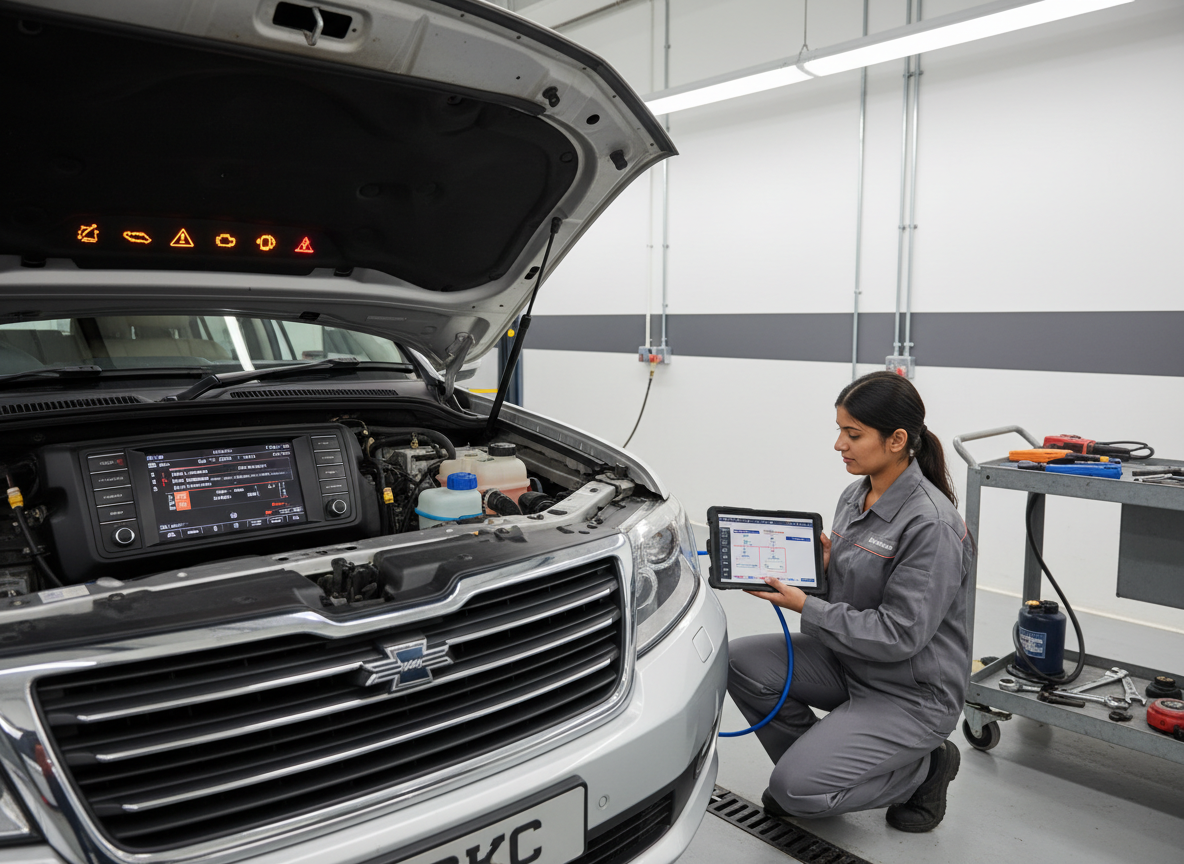
Dosing pump failure
The dosing pump pressurises the AdBlue supply line and delivers the correct volume of fluid to the SCR catalyst. When the pump motor begins to wear, it can no longer reach the required pressure — logging P20E8 and eventually causing P204F as catalyst efficiency drops. A failing pump rarely recovers on its own.
NOx sensor fault
The NOx sensor measures exhaust gas composition before and after the catalyst to verify the SCR system is working. When a sensor fails or its wiring degrades, the ECU can’t confirm catalyst efficiency and logs P20EE. On many Trafic and Master vans, the NOx sensor is a common wear item after 100,000 miles. For more detail on this, see our guide on why NOx sensor faults keep coming back.
Low-quality or contaminated AdBlue
This is genuinely worth ruling out before spending on parts. AdBlue must meet ISO 22241 specification (32.5% urea concentration). Supermarket and filling-station fluid is usually fine, but diluted or incorrectly stored fluid can cause a P207F even when all hardware is working correctly. Check the fluid concentration if you have any doubt about the source.
What Not to Do When You See an AdBlue Warning
Do not switch the engine off unnecessarily if you’re already in a countdown stage. Every engine restart uses one of your remaining start cycles. If the van is running and you’re heading to a garage, keep it running where possible rather than switching off at traffic lights or fuel stations.
Do not assume a code clear fixes the problem. Many garages will scan, clear the fault, and advise you to see how it goes. That resets the countdown but doesn’t fix the underlying issue. The code will return — often faster the second time, because the component condition hasn’t changed.
Do not just top up and hope for the best. If the warning appeared with a full tank, or came back within a few hundred miles of a refill, you have a hardware fault. See the section above on causes.
If you’re unsure which stage you’re at or what the fault code means, our AdBlue service page covers the full process for Stoke-on-Trent and Staffordshire vehicles, and we can advise over the phone before you come in.
Your Options: OE Repair vs Software Delete
Once you’ve identified the fault, you have two main paths:
OE-spec component repair
Replacing the faulty part — sensor, heater, pump, or NOx sensor — with a genuine or OE-equivalent component and coding it to the vehicle. This restores the system to factory spec and keeps the van MOT-compliant on emissions.
Best for: vans still under warranty, lease vehicles, or where maintaining the original system matters. Requires proper coding after fitment — not just plug-and-play.
AdBlue software delete
A calibration rewrite that disables the SCR system in the ECU, removing the warning, countdown, and no-start restriction permanently. No physical parts required. The MOT implications of an AdBlue delete are worth understanding before proceeding.
Best for: older vans out of warranty, high-mileage vehicles where component replacement cost is hard to justify, or vans already on a countdown. Increasingly common on Trafic and Master fleets.
Both options are available at Stoke Tuning. We cover Stoke-on-Trent, Newcastle-under-Lyme, and the wider Staffordshire and Cheshire area. If your Renault Trafic or Master is showing any of the warning stages above, call us on 07503 078486 to talk through the diagnosis before committing to a repair route.
Renault Trafic or Master AdBlue Fault?
We diagnose and fix AdBlue faults across Stoke-on-Trent, Staffordshire, and Cheshire. Call 07503 078486 or use the contact page to book a diagnosis.
Frequently Asked Questions
What causes the AdBlue warning light on a Renault Trafic?
The most common causes are a failing SCR quality sensor, AdBlue heater fault, dosing pump failure, or a NOx sensor reading out of range. Simply running low on AdBlue can trigger the initial warning, but if the light returns after a refill or a code clear, there is a hardware fault in the system.
Can I still drive my Renault Trafic with an AdBlue fault?
Yes — while the warning light is on or you’re in the countdown stage, the van can still be driven. However, once the countdown reaches zero, the ECU applies a no-start lockout and the van will not restart. If you’re already in a countdown, avoid switching the engine off unnecessarily, as every restart uses part of your remaining allowance.
Will resetting the fault code fix the AdBlue problem on my Renault Trafic?
No. Clearing the code resets the countdown and removes the immediate warning, but does not fix the underlying fault. The code will return — often within a few hundred miles — because the faulty component has not been repaired or replaced. A code clear should only be done after the root cause has been identified and fixed.
How much does it cost to fix an AdBlue fault on a Renault Trafic?
Cost depends on the faulty component. A quality sensor replacement is typically the least expensive fix. Dosing pump replacement and NOx sensor replacement cost more, particularly when you factor in parts coding. An AdBlue software delete is a fixed-cost alternative that removes the system permanently. Contact us for a quote specific to your fault code and van.
Is AdBlue delete legal in the UK?
AdBlue delete is legal for off-road or track use. For vehicles used on public roads, it is a modification that affects the emissions system, and you should understand the MOT implications before proceeding. We recommend discussing your specific situation with us before booking.
Conclusion
An AdBlue warning on a Renault Trafic or Master is rarely just a fluid-level issue. The warning stage system means you have a window to act — but that window closes. Whether you need an OE-spec sensor or pump repair, or a permanent delete, the important thing is getting a proper diagnosis from someone who can read the full fault history, not just the top-level code.
We work on Renault Trafic and Master vans across Stoke-on-Trent, Newcastle-under-Lyme, Leek, and wider Staffordshire. Call 07503 078486 to talk through your situation.