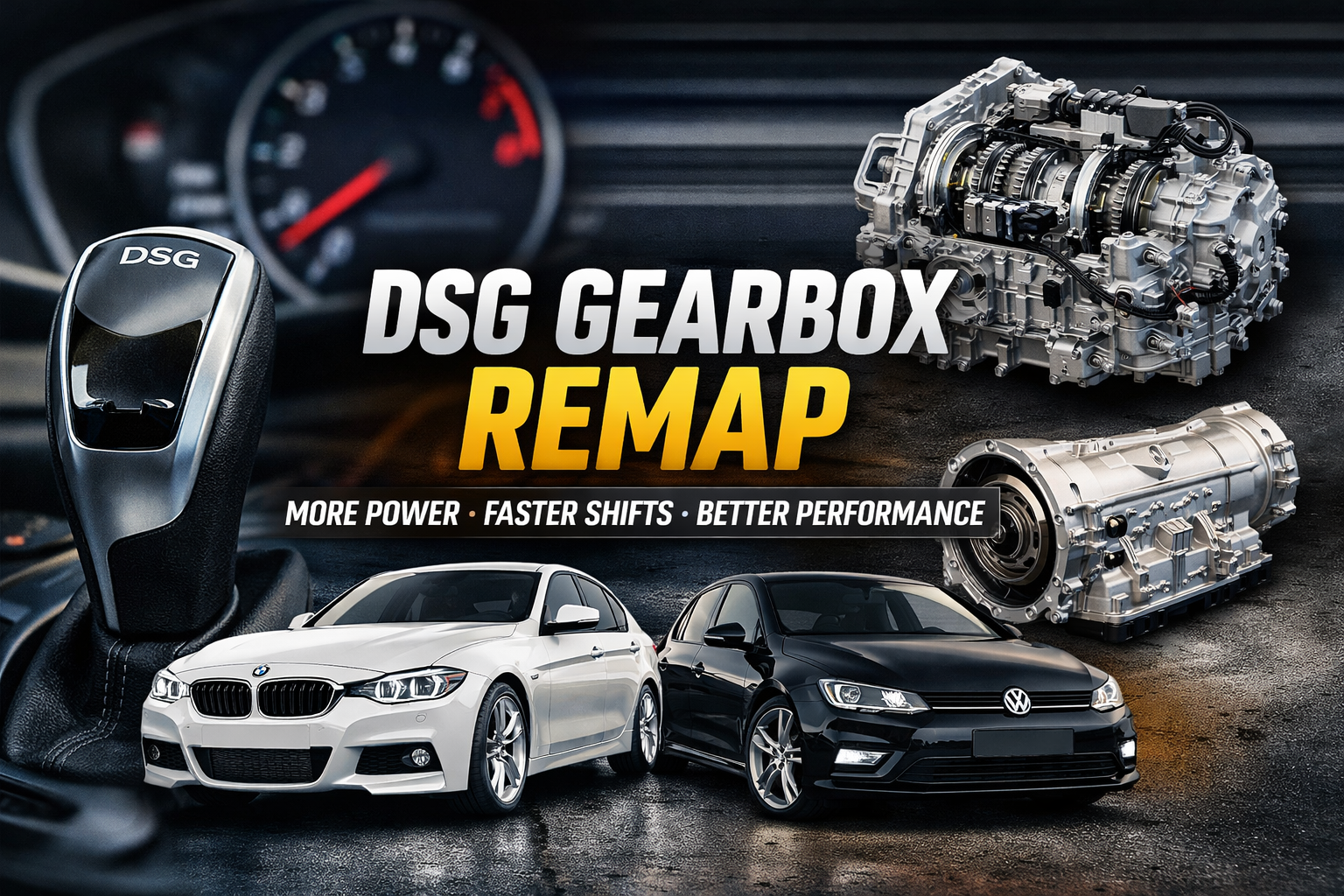
If you own a VAG or BMW vehicle with an automatic gearbox and you've had it remapped — or you're planning to — there's a good chance someone has mentioned a DSG gearbox remap at the same time. Most drivers nod along and move on. But it's a fair question: what exactly is being changed, does it make a real difference, and is it worth adding to the bill?
This guide answers all of that in plain English. We cover what a DSG remap changes inside the software, which gearboxes are supported, whether it should be paired with an engine remap, and what to expect from the process at Stoke Tuning.
Quick Answer
A DSG gearbox remap adjusts the software inside the transmission control unit (TCU) — the separate computer that manages gear changes. It can raise torque limits to match a tuned engine, sharpen shift speed and shift points, unlock true manual mode, and activate launch control where supported. It does not physically alter the gearbox. The result is a drivetrain that responds consistently with what the engine is now producing, rather than lagging behind it.
What is a DSG gearbox and how is it different from a standard automatic?
A DSG (Direct Shift Gearbox) is a dual-clutch transmission. Unlike a traditional torque converter automatic — where a fluid coupling manages the connection between engine and gearbox — a DSG uses two separate clutch packs working in parallel. While one gear is engaged and driving the vehicle, the next gear is already pre-selected and ready to go. This is what gives DSG-equipped cars their fast, near-seamless gear changes.
VAG Group — Volkswagen, Audi, SEAT, Skoda, and CUPRA — brought DSG to mass-market cars from the early 2000s. BMW took a different approach, standardising on the ZF 8-speed torque converter automatic across much of its range. That gearbox has since found its way into vehicles from Jaguar, Land Rover, and select Audi longitudinal-engined models too.
Both types are governed by a dedicated transmission control unit (TCU). That TCU contains software that controls everything from when the gearbox shifts, how fast it shifts, how much torque it allows through, and what behaviour it displays in each drive mode. Like an engine ECU, the factory software is conservative — calibrated for reliability across a wide range of drivers and conditions. A gearbox remap is the process of adjusting that software so it works properly for how the car is actually being used, especially after the engine has been tuned.
What does a DSG gearbox remap actually change?
A DSG remap works on the TCU software rather than any physical component. The specific changes possible depend on the gearbox variant, but these are the most common and most impactful adjustments.
Torque limits
Every DSG has a torque limit built into its software. In standard form, this protects the gearbox from the engine's maximum output. When an engine is remapped and begins producing more torque, the TCU's limit can become a bottleneck — either capping the gains the engine is making, or causing the gearbox to throw fault codes under load. A DSG remap raises the torque limit inside the TCU to match what the engine is now producing. For Stage 2 builds in particular, this is not optional — it is the step that lets the engine and gearbox work as a matched pair.
Shift speed and shift points
Factory shift programming prioritises smoothness and fuel economy. A remap can sharpen the speed of gear changes and adjust the RPM points at which upshifts happen in Drive and Sport modes. The gearbox feels more connected to the engine and less like it is always one beat behind driver input.
Launch control
Some DSG variants support launch control but have it disabled in the factory software. Where the hardware allows, a remap can activate this — allowing the gearbox to hold a set rev limit on a standing start for a cleaner, more consistent pull away. This is gearbox and model dependent, so it is worth confirming before booking.
Kickdown removal and true manual mode
In standard software, pressing the accelerator fully in automatic mode triggers a kickdown downshift even if the driver is in manual mode — overriding the selected gear. A remap removes this so the gearbox stays in the gear chosen by the driver. At the same time, the automatic upshift that occurs at the rev limiter in manual mode can be disabled, giving genuine full control over when to change up.
Which gearboxes are supported?
VAG DSG gearboxes
VAG runs several DSG variants across its range. Knowing which one is fitted to your vehicle matters before booking remap work.
| Gearbox | Speeds / Clutch type | Commonly found in |
|---|---|---|
| DQ250 | 6-speed, wet clutch | Golf Mk5–7 GTI/TDI, Passat, Audi A3, many TDI applications |
| DQ381 | 7-speed, wet clutch | Golf GTI/R Mk7–8, Audi S3, CUPRA models |
| DQ500 | 7-speed, wet clutch | VW Transporter T6/T6.1, Tiguan, Audi RS3, TT-RS |
| DQ200 | 7-speed, dry clutch | Golf, Polo, and lower-powered VAG models |
The wet-clutch units — DQ250, DQ381, and DQ500 — are the most tuneable. The DQ200 (dry clutch) is more limited in what calibration work is possible and is better suited to lower-torque applications.
BMW and ZF 8-speed gearboxes
BMW uses the ZF 8HP across the majority of its petrol and diesel range — 3 Series, 5 Series, 7 Series, X3, X5, and beyond. The same gearbox is found in some Audi longitudinal-platform models (A4, A5, A6, A7, Q5) and in a number of Jaguar and Land Rover vehicles.
The ZF 8HP TCU can be remapped to adjust torque limiters, shift speed, Sport mode sharpness, and kickdown behaviour. For BMW diesel owners — particularly those on a B47 or N57 engine that has already been remapped — pairing that engine work with a ZF gearbox remap is well worth exploring. The gearbox calibration can be brought into line with the engine tune in the same session.
A note on compatibility
Not every gearbox variant supports the same level of calibration, and compatibility can vary by model year and software version. Before booking, it is always worth confirming your gearbox type and vehicle details so the right approach can be agreed upfront.
Should you remap the DSG at the same time as the engine ECU?
For anyone doing a Stage 2 remap, this is an important question — and the short answer is yes, it should be part of the conversation. Stage 2 work often involves hardware upgrades alongside the software changes, and the engine can be producing substantially more torque than stock. If the TCU is not recalibrated to match, the gearbox may limit the power reaching the wheels, generate fault codes under load, or shift in a way that undermines the performance gains from the engine tune.
For Stage 1 drivers, it is less critical but still makes the overall package feel sharper. Stage 1 adds power within the engine's safe envelope and the gearbox can typically handle the torque, but the TCU will still be calibrated for stock shift behaviour. Remapping both in the same session means the gearbox responds at the same pace the engine does, and the whole drivetrain feels more cohesive.
There is also a practical argument for doing both together. The vehicle is on site once, the calibration can be set up with the engine and gearbox working as a matched pair from the start, and there is no need to return for a second appointment.
What does a DSG gearbox remap cost?
Pricing varies depending on the gearbox type, the vehicle, and whether the work is being carried out alongside an engine remap. The VAG wet-clutch units and the ZF 8-speed are the most commonly supported options and are priced differently.
As a general point, combining a gearbox remap with an engine remap in the same session is more cost-effective than booking them separately. The most accurate way to get a figure is to get in touch with your vehicle details — the team can confirm exactly what is possible for your specific model and gearbox, and quote accordingly. Call 07503 078486, email stoketuning@gmail.com, or message via WhatsApp.
How Stoke Tuning approaches DSG remap work
Stoke Tuning uses genuine Autotuner hardware to read and write to both engine ECUs and transmission control units. Before any changes are made, the original TCU file is backed up — so the gearbox can always be returned to factory settings if needed.
A diagnostic scan is run before the remap to confirm the gearbox is in good health. There is no point calibrating a gearbox that has underlying faults or stored codes. If anything needs attention first, that gets flagged clearly.
Work is available at the workshop on Roxburghe Avenue in Stoke-on-Trent, or as a mobile appointment. The mobile service covers Stoke-on-Trent, Staffordshire, the Moorlands, and Cheshire East. After the remap, the vehicle is driven to confirm the calibration is working as intended. If anything needs adjustment, it is sorted before the car leaves.
For more on what the full gearbox tuning service covers, visit the DSG and auto gearbox tuning service page.
Want to know if a DSG remap is right for your vehicle?
Get in touch with the team at Stoke Tuning and we'll confirm what's possible for your gearbox type and engine combination. We can quote for the DSG remap on its own or as part of a combined engine and gearbox package.
Call 07503 078486 · Email stoketuning@gmail.com · WhatsApp available
Workshop on Roxburghe Avenue, Stoke-on-Trent · Mobile service available across Staffordshire, the Moorlands and Cheshire East
In summary
A DSG gearbox remap is not a cosmetic add-on. It is the calibration step that makes sure the gearbox actually keeps pace with what the engine is producing after a tune. For Stage 2 builds it is genuinely important — the TCU needs to match the engine's increased torque output. For Stage 1 owners it rounds out the package and makes the drivetrain feel properly connected. The key is confirming the right approach for your specific gearbox variant, whether that is a VAG wet-clutch DSG or a ZF 8-speed in a BMW.
If you have questions before booking, the Stoke Tuning team is straightforward to reach by phone, email, or WhatsApp.
Frequently asked questions
Will a DSG gearbox remap affect my manufacturer warranty?
Any software modification can affect the manufacturer warranty on related components. If your vehicle is still within a main dealer warranty period, it is worth checking the terms before proceeding. For vehicles outside the original warranty, this is generally not a concern in the same way.
Can a DSG remap cause gearbox damage?
A correctly calibrated remap works within the mechanical limits of the gearbox. The adjustments are to shift logic and torque handling parameters, not to any physical component. If the gearbox already has an existing fault or wear issue, that needs to be addressed first — which is why a diagnostic check is carried out before any remap work takes place.
Is a DSG gearbox remap reversible?
Yes. The original TCU file is stored before any changes are written. The gearbox can be returned to its factory calibration at any point if required.
Which VAG DSG gearbox responds best to remap work?
The wet-clutch units — DQ250, DQ381, and DQ500 — offer the most scope for calibration and are the most commonly tuned. The DQ200 (7-speed dry clutch) found in lower-powered VAG models is more limited. If you're unsure which gearbox your vehicle has, the team can confirm this from your vehicle registration before you commit to anything.
Do I need a Stage 2 engine remap before a DSG gearbox remap makes sense?
No. A gearbox remap improves shift behaviour, manual mode control, and throttle response regardless of whether the engine has been remapped. Stage 2 makes the TCU recalibration more important because the additional engine torque needs to be matched in the gearbox software. Stage 1 owners still benefit, but the gains are more about feel and response than managing increased power.