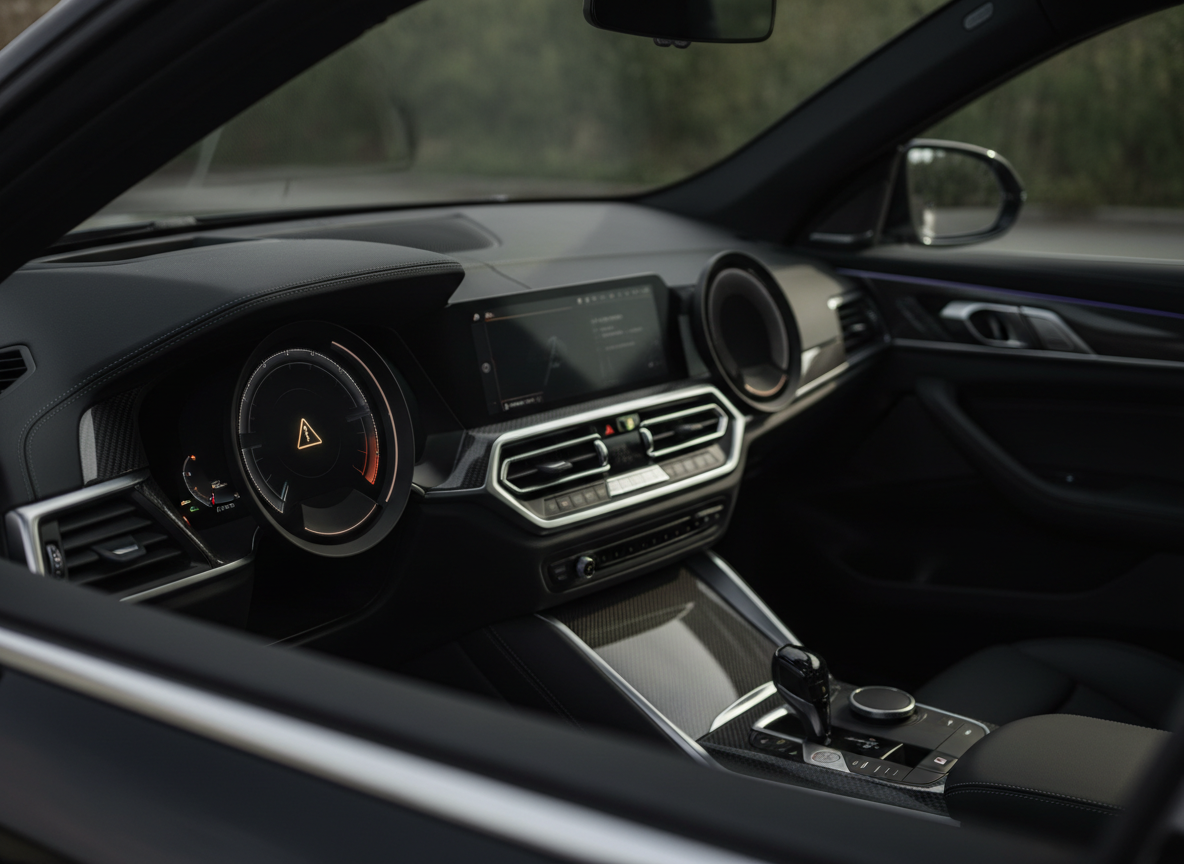
BMW AdBlue Warning Light: What It Means and What Your Options Are
BMW’s AdBlue warning system has several stages before the engine locks out completely. Most drivers don’t know what each message means until they’re stranded. This guide covers every BMW AdBlue warning stage, the most common fault causes beyond an empty tank, and what to do about it.
In This Guide
- Which BMW models have AdBlue?
- How BMW’s AdBlue warning countdown works
- Common BMW AdBlue fault causes (beyond low fluid)
- What happens when BMW locks the engine out
- Topping up BMW AdBlue yourself
- AdBlue repair vs AdBlue delete — what’s the difference?
- FAQs
Which BMW Models Have AdBlue?
BMW started fitting Selective Catalytic Reduction (SCR) systems — which require AdBlue — on diesel models from around 2014, in response to tightening Euro 6 emissions regulations. The system is now standard across the diesel range.
Models affected include the 1 Series (F20/F40), 2 Series, 3 Series (F30/G20), 4 Series, 5 Series (F10/G30), X1, X3, X5, and 7 Series with B47 and B57 diesel engines. If your BMW is a diesel registered from 2015 onwards, there is almost certainly an AdBlue system fitted, even if you’ve never seen a warning for it yet.
The AdBlue tank is separate from the fuel tank. On most BMW models it is accessed either via a flap near the fuel filler cap or under the boot floor. Tank capacity varies by model but typically sits between 15 and 25 litres. BMW recommends topping up at each oil service, but consumption varies depending on driving style and how hard the engine is working.
B47 and B57 engines: BMW’s B47 (4-cylinder diesel) and B57 (6-cylinder diesel) are the most commonly affected engines for AdBlue faults. Both use the same SCR system architecture and share similar failure patterns, particularly around the NOx sensors and AdBlue injector.
How BMW’s AdBlue Warning Countdown Works
BMW’s AdBlue warning system is deliberately graduated. It doesn’t just light a warning and wait for you to act — it applies increasing pressure at set mileage thresholds.
| Warning stage | What appears on the dashboard | Action required |
|---|---|---|
| ~2,400 miles remaining | Yellow warning light, message: “AdBlue — fill up when next refuelling” | Top up at your convenience |
| ~1,500 miles remaining | Amber warning, more frequent message | Top up as soon as possible |
| ~800 miles remaining | Red warning, persistent message every start cycle | Top up immediately |
| ~200 miles remaining | Red warning with countdown in miles | Do not delay — engine start will be refused |
| 0 miles / tank empty | Engine start refused after next restart | Vehicle cannot be started until AdBlue is added |
The final lockout is not a rumour — BMW’s system will refuse to allow the engine to restart once the AdBlue level reaches zero and the vehicle is switched off. This can happen at an inconvenient time and location if the warnings are repeatedly ignored.
Important distinction: A low-level warning and a system fault warning look similar on the dashboard but have different causes and different solutions. A low level requires a top-up. A fault code — even with a full tank — indicates a problem with the SCR system itself.
Common BMW AdBlue Fault Causes Beyond Low Fluid
Many BMW owners top up their AdBlue, see the warning light disappear, and assume all is well — only for the warning to return within days or weeks. This usually means the fault isn’t a low level issue. These are the most common system-level causes.
NOx Sensor Failure
The SCR system uses two NOx sensors — one upstream and one downstream of the catalytic converter — to measure exhaust gas composition and confirm the system is reducing emissions as intended. When a NOx sensor fails, the ECU loses its ability to verify SCR performance and raises a fault. The warning light comes on even with a full AdBlue tank, and the countdown continues regardless of how much fluid is present.
NOx sensors are a known wear item on BMW diesels. The upstream sensor (pre-SCR) tends to fail before the downstream sensor. Replacement is straightforward but sensor coding to the ECU is required on most BMW platforms.
AdBlue Injector Fault
The AdBlue injector sprays fluid into the exhaust stream at a calculated rate. It operates in a hot, corrosive environment and is vulnerable to crystallisation — particularly if the vehicle sits for extended periods without the system completing its post-shutdown purge cycle. A blocked or failed injector triggers a dosing fault code, and the SCR system stops operating.
AdBlue Pump and Tank Heater
AdBlue freezes at -11°C. BMW’s system includes a tank heater that keeps the fluid at operating temperature in cold conditions. When the heater fails — a common issue on 3 Series F30 and 5 Series F10 models in particular — the pump cannot draw fluid from the frozen tank and the system logs a supply fault. This typically appears during cold spells but the underlying electrical fault may persist year-round.
Contaminated AdBlue
AdBlue is a high-purity fluid. Adding the wrong concentration, using low-quality fluid, or accidentally contaminating the tank with fuel or water causes the quality sensor to raise a fault. Contamination requires draining and flushing the entire AdBlue system before fresh fluid is added — topping up over contaminated fluid will not clear the fault.
SCR Catalyst Degradation
The SCR catalyst itself has a lifespan. On very high mileage vehicles — particularly those used mainly on short journeys where the SCR system never reaches full operating temperature — the catalyst can degrade to the point where it can no longer reduce NOx to the level the downstream sensor expects. This triggers a persistent fault that can’t be resolved with a fluid top-up or sensor replacement.
What Happens When BMW Locks the Engine Out
Once an AdBlue-related lockout is triggered, the BMW will display a message stating that the vehicle cannot be started. This is a hard block — not a limp mode and not a temporary restriction. The engine will not start until either the AdBlue level is restored (for low-level lockouts) or the fault is cleared by a diagnostic interface (for system faults).
If you’re stranded, a mobile top-up of AdBlue will resolve a pure level lockout. If the system has a fault code active, topping up won’t help — the fault needs to be read and cleared with diagnostic equipment, and the underlying problem needs to be addressed before the car will start.
Attempting to bypass the lockout by disconnecting the battery or using cheap code readers to clear the fault without fixing the underlying issue is a temporary measure at best. The fault will return within a short drive once the ECU completes its monitoring cycles.
Topping Up BMW AdBlue Yourself
Topping up your own AdBlue is straightforward on most BMW models. You need AdBlue that meets ISO 22241 specification — most supermarkets and motor factors sell this in 5 or 10 litre containers.
- Locate the AdBlue filler — usually near the diesel filler cap or under the boot floor. It has a blue cap.
- Use a funnel or a container with a pouring nozzle that fits the filler neck correctly. BMW’s filler neck is smaller than some other brands.
- Add at least 5 litres to register on the system — adding 1 or 2 litres may not trigger the sensor to update.
- Start the engine. The warning should clear after the ECU reads the updated level — this may take a start cycle or two.
If the warning doesn’t clear: If the light stays on after adding fluid and the tank is confirmed full, you have a system fault — not a level issue. A diagnostic scan is the next step. Continuing to add fluid won’t resolve a sensor or injector fault.
BMW AdBlue Repair vs AdBlue Delete — What’s the Difference?
When the AdBlue system develops a recurring fault — particularly when the cost of genuine BMW replacement parts is involved — many owners explore whether deletion or software-based removal is an option.
AdBlue Repair
Repair involves identifying and replacing the specific failed component — NOx sensor, AdBlue injector, pump, heater, or a combination. On a BMW with a single component failure and an otherwise healthy SCR system, this is often the most straightforward path. The system continues to operate, the vehicle remains fully compliant with its original specification, and no software changes are made.
AdBlue Delete
AdBlue delete is a software modification that instructs the ECU to ignore the AdBlue system entirely. No fault codes are generated, no countdown begins, and the engine lockout mechanism is removed. This is typically used when the SCR system has suffered multiple failures, when the cost of repair exceeds the vehicle’s value, or when the vehicle is being prepared for non-road use or export to a market without SCR requirements.
At Stoke Tuning, we can discuss both options based on your specific vehicle, its fault history, and what makes sense given the mileage and condition. We’ll give you a straight answer about what’s most cost-effective in your situation.
BMW AdBlue Fault? Let’s Sort It.
Whether it’s a top-up issue, a NOx sensor, or you want to explore deletion — Stoke Tuning & Adblue Repair diagnoses and resolves BMW AdBlue problems across the full model range. Based in Stoke-on-Trent, covering Staffordshire and beyond. Call us or use the contact form to explain your situation and we’ll advise the right course of action.
Frequently Asked Questions
How much AdBlue does a BMW use?
BMW’s AdBlue consumption varies but averages around 1–1.5 litres per 1,000 miles under normal driving conditions. Aggressive driving, towing, or lots of motorway use increases consumption. Most owners need to top up every 8,000–12,000 miles, though BMW typically tops up at each service interval. Check your warning messages to see how much driving range remains.
Can I put any AdBlue in a BMW?
No. BMW requires AdBlue that meets ISO 22241 specification — a 32.5% urea solution in deionised water. Using automotive-grade urea products that don’t meet this standard, or diluting the fluid, will contaminate the tank and trigger a quality fault. Always use a branded, ISO-certified AdBlue product.
Will BMW AdBlue problems affect my MOT?
An active AdBlue system fault can cause the engine management light to remain illuminated. An illuminated EML is an MOT failure. Additionally, an SCR system that isn’t functioning correctly may affect emissions readings during the MOT test, potentially causing a failure on NOx output. Both issues need to be resolved before presenting the vehicle for test.
How long can I drive with an AdBlue warning on a BMW?
With a low-level warning, BMW gives you a graduated countdown — typically starting at around 2,400 miles remaining. If it’s a system fault rather than a level issue, the countdown may not be displayed but the fault needs attention before the next service cycle or it will escalate. Driving with a fault active risks a NOx-related lockout at the worst possible moment.
Is BMW AdBlue delete legal?
AdBlue delete involves modifying the vehicle’s emissions control software. Under UK law, vehicles modified in this way are not legal for use on public roads and would fail an emissions-based MOT check if tested correctly. Deletion is typically used for vehicles that are no longer road registered, being prepared for export, or for off-road or track use. Stoke Tuning will discuss your individual situation and what applies to your use case.