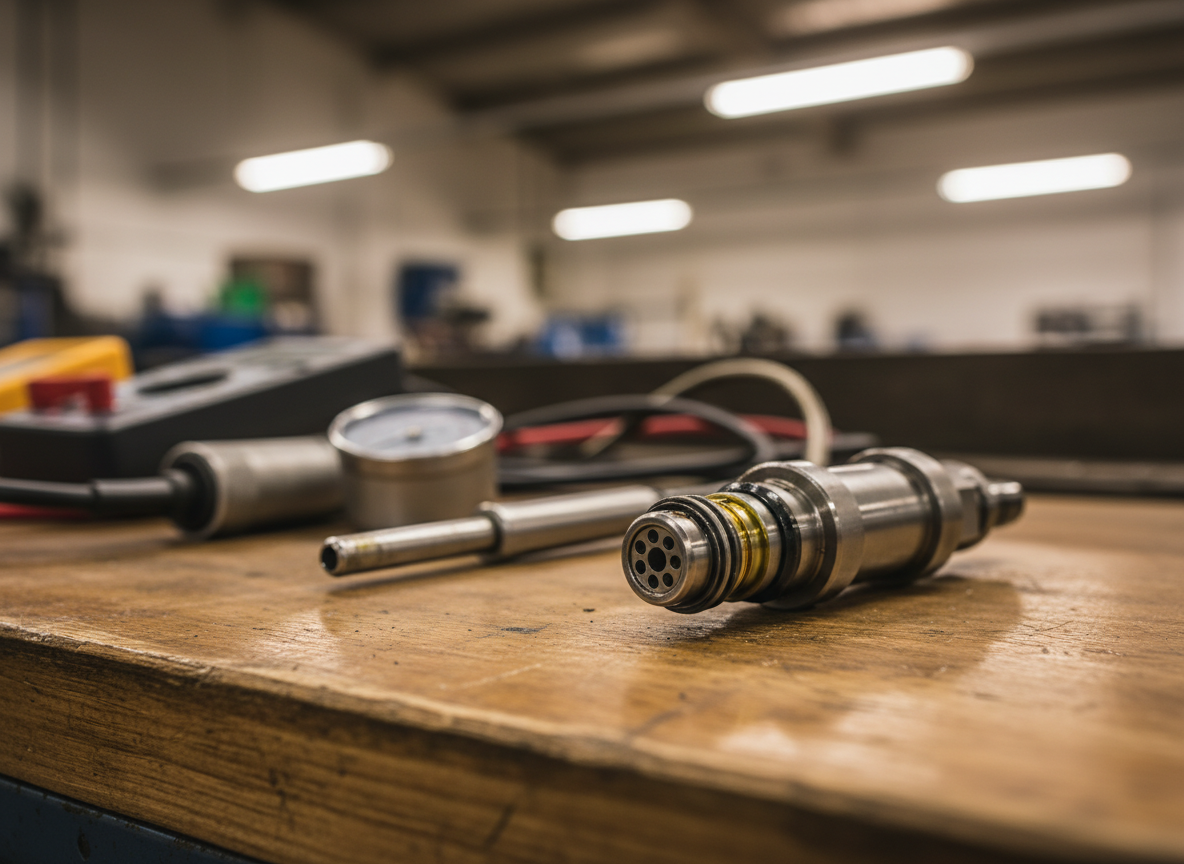
Diesel Injector Problems: Symptoms, Diagnosis, and Your Repair Options
A rough-running diesel, loss of power, or smoke from the exhaust that won’t clear — injector problems are one of the most common causes, and one of the most commonly misdiagnosed. Here’s what the symptoms actually mean, how injectors are properly diagnosed, and what your options are when one fails.
In This Guide
- What diesel injectors do and why they fail
- Eight symptoms of a failing diesel injector
- How injector faults are diagnosed properly
- How injector problems affect the DPF, EGR, and turbo
- Injector repair and replacement options
- Injector replacement cost in the UK
- FAQs
What Diesel Injectors Do — and Why They Fail
Modern diesel engines use common rail direct injection. Fuel is pressurised to extreme levels — typically 1,600 to 2,000 bar in a modern system — and held in a common fuel rail. Each injector is a precision electro-hydraulic valve controlled by the ECU, firing multiple times per combustion cycle at exact durations to deliver the right amount of fuel at the right point.
The tolerances inside a diesel injector are extraordinarily tight — measured in microns. That precision is also what makes them vulnerable. Any contamination in the fuel, any wear on the internal components, or any electrical fault in the solenoid or piezo actuator changes how the injector behaves — and the engine notices immediately.
Common Causes of Injector Failure
- Normal wear at high mileage: Injectors are designed to last 100,000–150,000 miles under ideal conditions, but real-world conditions vary considerably.
- Fuel contamination: Water in the fuel — from a failing lift pump seal, a faulty fuel cap, or condensation in a tank left low — causes internal corrosion and deposits that interfere with the needle lift mechanism.
- Low-quality fuel: Fuel lubricity varies between suppliers. Consistently using low-quality or watered-down diesel accelerates injector wear faster than mileage alone would suggest.
- Blocked fuel filter: Running a diesel with a restricted fuel filter puts the high-pressure pump and injectors under increased stress, accelerating internal wear.
- Carbon and lacquer deposits: Heat cycles and combustion deposits build up on the injector tip and needle, affecting spray pattern and atomisation quality.
Eight Symptoms of a Failing Diesel Injector
1. Rough or Lumpy Idle
A diesel with a failing injector typically idles unevenly. The engine shakes more than normal, particularly at low revs and when stationary. This happens because the affected cylinder isn’t receiving its proper fuel charge — or is receiving too much — creating an imbalance in combustion timing across the engine. The roughness often worsens when the engine is cold and may partially improve once warm.
2. Loss of Power Under Load
At higher loads — overtaking, uphill driving, towing — a partially failed injector struggles to deliver the fuel volume the ECU is requesting. The result is a flat spot, hesitation, or a general feeling that the engine isn’t pulling as strongly as it should. This symptom often arrives gradually, making it easy to attribute to other causes.
3. Increased Fuel Consumption
An injector that is leaking — dribbling fuel into the cylinder when it should be closed — or one that isn’t atomising fuel properly causes incomplete combustion. The engine effectively wastes fuel, and mpg drops noticeably. If your fuel consumption has increased without a change in how or where you drive, injector condition is worth investigating.
4. Black Smoke Under Acceleration
Heavy black smoke from the exhaust under hard acceleration typically indicates an over-fuelling condition — the injector is delivering more fuel than the engine can fully combust. A sticking or leaking injector can cause this. Some black smoke under hard acceleration is normal on older diesels, but persistent heavy smoke across normal driving ranges is not.
5. White Smoke at Idle or Low Speed
White or grey smoke that doesn’t clear after the engine warms up often indicates unburned fuel passing through the exhaust. This can be caused by a leaking injector allowing raw diesel into the cylinder when the engine isn’t firing, or by an injector that isn’t atomising correctly and leaving droplets of fuel to combust incompletely. White smoke is also associated with coolant entering the combustion chamber — so this symptom warrants careful diagnosis to identify the correct cause.
6. Engine Management Light with Misfire Code
The ECU monitors cylinder contributions to engine output. When one cylinder consistently underperforms, a misfire code is logged for that cylinder. Common codes associated with injector faults include P0200–P0209 (injector circuit faults), P0300 (random misfire), and cylinder-specific misfires like P0301–P0304. Injector balance rate data — visible on a capable diagnostic tool — is often more informative than the fault codes themselves.
7. Diesel Smell from the Engine Bay
A strong diesel smell that wasn’t present previously — particularly after the engine has been running — can indicate an external injector leak. The high-pressure fuel connections on common rail injectors can develop leaks at the return pipe unions or at the injector body itself. Any external fuel leak on a running engine is a fire risk and needs immediate attention.
8. Hard Start After a Warm Soak
Diesels that start easily cold but struggle to restart when warm — the “hot start” problem — are sometimes exhibiting injector leak-back symptoms. A leaking injector allows fuel pressure to bleed back from the rail when the engine is switched off. When restarting, the system takes longer to rebuild rail pressure, resulting in an extended crank before the engine fires. Injector leak-back can be tested directly with specific diagnostic tools.
How Injector Faults Are Diagnosed Properly
Injector diagnosis is an area where the quality of the diagnostic process matters enormously. Generic fault code readers tell you a misfire exists on a cylinder. Professional diagnostic equipment tells you why — and that distinction is what prevents unnecessary parts replacements.
Injector Balance Rate Testing
The ECU constantly adjusts the pulse width (on-time) of each injector to keep combustion balanced across all cylinders. When one injector underperforms, the ECU adds extra fuel to compensate — its balance rate goes positive (adding more). When one over-delivers, the rate goes negative (trimming back). Viewing live balance rate data shows exactly which cylinder and which injector is causing the problem — often before any fault code is stored.
Injector Leak-Back Testing
Leak-back testing measures how much fuel each injector returns to the tank when a measured amount of fuel is delivered to the rail. Excessive return flow from one injector indicates worn internal components that can’t hold back pressure effectively. This test identifies injectors that are failing mechanically even when electrical tests show no fault.
Cylinder Cut-Out Test
By temporarily disabling individual injectors during idle and observing the effect on engine smoothness, a technician can identify which cylinder is contributing least — pointing to either a weak injector or a mechanical problem with that cylinder (compression, timing, etc.).
Compression Test
If injector testing doesn’t produce a clear result, compression testing rules out mechanical causes — worn piston rings, valve seat issues — that produce similar symptoms to injector faults. A low-compression cylinder combined with normal injector data points away from the injector and toward the engine itself.
Don’t guess: Diesel injectors are expensive components. A replacement set for a modern common rail diesel can cost £800–£1,500 for parts alone. Proper diagnostic work before ordering parts is not a luxury — it’s how you avoid replacing the wrong component.
How Injector Problems Affect the DPF, EGR, and Turbo
A failing injector rarely affects only that cylinder in isolation. The knock-on effects through the rest of the engine system can create secondary faults that obscure the original cause.
DPF impact
An injector that over-fuels or causes incomplete combustion sends additional soot into the exhaust. This accelerates DPF loading and shortens the interval between regenerations. A blocked DPF on a diesel with an injector fault is a common combination — and replacing the DPF without fixing the injector just repeats the problem.
EGR impact
Increased combustion deposits from a misfiring cylinder accelerate EGR valve fouling. The sticky carbon deposits that accumulate in the EGR system build up faster when combustion quality is compromised. An EGR fault that develops quickly after running with a known injector problem almost always traces back to the injector as the root cause.
Turbo impact
Unburned fuel reaching the turbo creates carbon deposits on the turbine blades and can wash oil film from the bearings in severe cases. Turbos on engines with chronic injector misfire tend to wear faster than those on engines running cleanly. This is particularly relevant on variable geometry turbos where carbon deposits affect the vane movement.
Injector Repair and Replacement Options
Injector Cleaning
For injectors that are fouled with deposits but mechanically sound, professional ultrasonic cleaning can restore spray pattern and balance rates close to factory specification. This is typically done off-car on specialist equipment. It’s a cost-effective option for injectors that are performing poorly due to contamination or carbon buildup rather than wear. Not all injectors are suitable candidates — highly worn or physically damaged injectors won’t benefit from cleaning alone.
Injector Replacement and Coding
When an injector is beyond cleaning or has failed mechanically, replacement is required. Modern common rail injectors are not plug-and-play components. Each injector has a unique correction code — sometimes called an IMA code, C2I code, or similar depending on the manufacturer — that tells the ECU exactly how that specific injector performs. This code must be entered into the ECU after fitting a replacement, otherwise the ECU calibrates incorrectly and the engine runs poorly.
This coding step is one of the most commonly skipped or incorrectly performed parts of an injector replacement when the job isn’t done by a specialist. A correctly fitted but uncoded injector will still cause rough running and may generate misfire codes.
Full Set Replacement
When multiple injectors are approaching the end of their service life, or when contaminated fuel has affected the entire set, replacing all injectors at once is often the most cost-effective long-term approach. The labour cost of returning to fit additional injectors individually over the following months often exceeds the saving from doing them one at a time.
| Option | Typical cost range | Best for |
|---|---|---|
| Single injector replacement (4-cyl) | £300–£600 | One failed injector, others healthy |
| Full set replacement (4-cyl) | £900–£1,800 | Multiple worn injectors, contamination |
| Injector cleaning (per injector) | £60–£120 | Carbon-fouled injectors, good underlying condition |
| Injector coding only | £60–£100 | New injectors already fitted but not coded |
Always diagnose before replacing: The figures above assume the injector is confirmed as the faulty component. Fitting new injectors without confirming this through proper diagnostics first can leave the root cause unresolved while spending significant money on the wrong part.
Diesel Running Rough? Get It Properly Diagnosed
Injector faults, misfires, and smoke from the exhaust are the kind of problems that need proper diagnostic work — not guesswork. At Stoke Tuning & Adblue Repair, we use professional equipment to read balance rates, live data, and injector performance before any parts are recommended. Based in Stoke-on-Trent, covering Staffordshire and surrounding areas.
Frequently Asked Questions
Can I drive with a bad diesel injector?
Short distances in a non-emergency may be possible if symptoms are mild — rough idle only, no smoke, no power loss. But a misfire puts strain on the DPF, accelerates EGR fouling, and can damage the catalytic converter with excess unburned hydrocarbons. An injector that is leaking externally is a fire risk and should not be driven at all. If you’re unsure, get it checked before driving further.
How do I know if it’s an injector or a glow plug?
Both can cause rough idle, hard cold starts, and engine management lights. The key difference is in the fault codes and live data. A glow plug fault shows as a glow plug circuit code (P0380 range). An injector fault typically shows as an injector circuit code (P0200 range) or a misfire code that persists at all temperatures, not just cold. Balance rate data often makes the distinction clear — a heavily trimmed cylinder at all temperatures points to the injector.
Can a diesel injector be repaired instead of replaced?
In some cases, yes. Specialist injector remanufacturers can overhaul worn injectors — replacing the needle, shim, and solenoid — to bring them back to factory specification. This is typically cheaper than a new OEM injector and may be the right call on higher-value vehicles where OEM-spec reliability is important. Cheap pattern-part injectors are not always the right answer on modern common rail systems where tolerance is everything.
Will a diesel injector fault affect the turbo?
Over time, yes. An injector that causes incomplete combustion sends excess unburned fuel and soot through the turbo. This deposits carbon on the turbine and, in severe cases, can contribute to bearing wear. Variable geometry turbos are particularly vulnerable to carbon deposits affecting vane movement. Fixing the injector fault early protects the turbo from accumulating unnecessary damage.
How long do diesel injectors last?
Well-maintained common rail injectors typically last 100,000–150,000 miles under normal conditions. City driving, contaminated fuel, or an overdue fuel filter change shortens this significantly. On vehicles above 100,000 miles showing rough running or increased fuel consumption, injector condition should be part of any diagnostic investigation rather than being assumed to be fine because no fault code is stored.