
DSG Remap Explained: What Changes, What to Expect & Is It Worth It?
A DSG or automatic gearbox remap changes the way your transmission behaves — shift speed, torque limits, shift points, and launch response. But what exactly gets changed, which vehicles can benefit, and what does it feel like to drive afterwards? This guide explains it clearly.
What Is a DSG Gearbox?
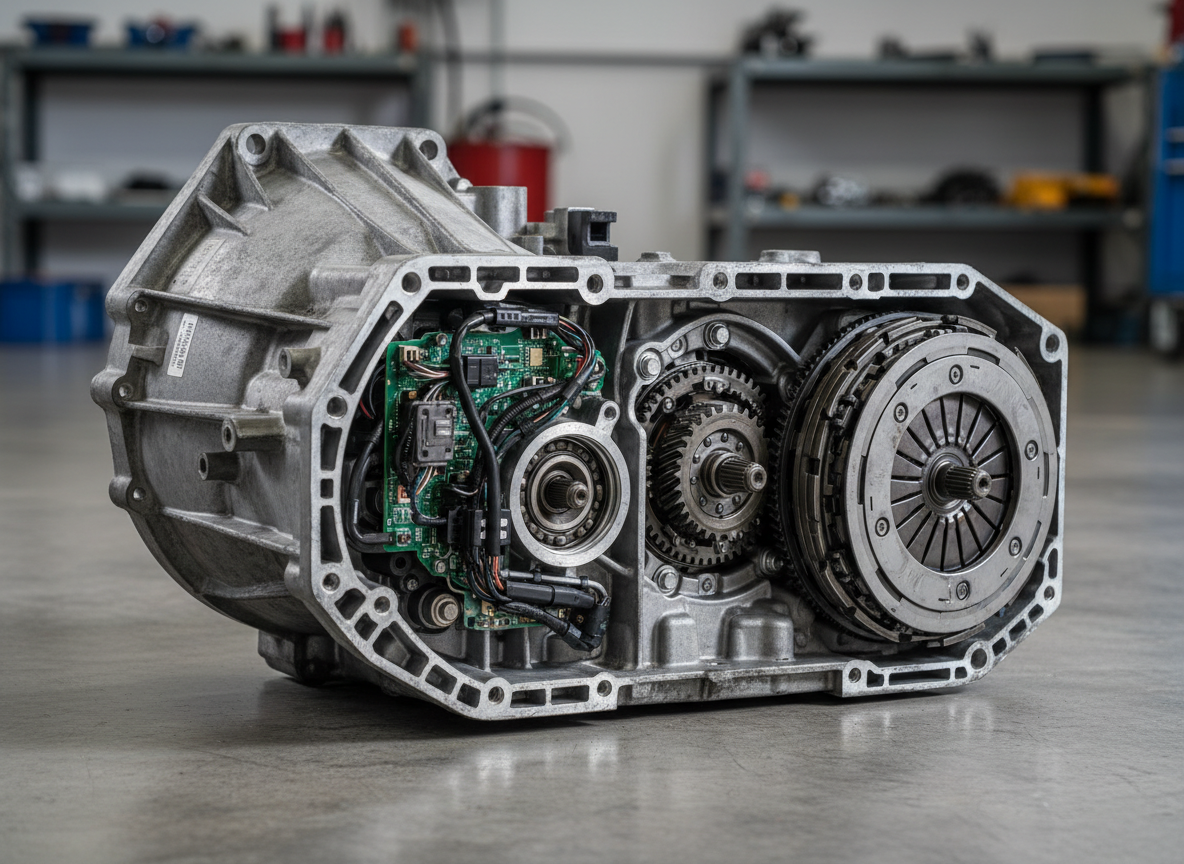
DSG stands for Direct Shift Gearbox — it is Volkswagen Group’s name for their dual-clutch automatic transmission (DCT). The same technology appears under different names across the industry: PDK in Porsche, DCT in BMW, EDC in Renault, PowerShift in Ford.
Unlike a traditional automatic with a torque converter, a dual-clutch gearbox uses two separate clutch packs — one for odd gears, one for even gears. This allows the next gear to be pre-selected and engaged almost instantly, giving shift times that are faster than most manual gearbox drivers can achieve on their own.
The gearbox is controlled by its own Transmission Control Unit (TCU) — a separate ECU that manages clutch engagement, shift timing, torque limits, and shift strategy based on throttle position, speed, engine load, and driver mode selection.
What Does a DSG Remap Actually Change?
The TCU map controls everything about how the gearbox behaves. A remap adjusts the parameters that govern:
Shift behaviour
- Shift speed — how quickly the gearbox moves between gears (faster = more responsive, but harder on clutch packs)
- Shift points — the RPM at which upshifts and downshifts trigger
- Kickdown behaviour — how aggressively the gearbox drops gears under hard acceleration
- Sport mode response — making sport mode genuinely sporty rather than marginally different from comfort
Torque & clutch limits
- Torque limit — the TCU caps how much torque the gearbox will accept; a remap raises this to match a remapped engine
- Clutch clamping pressure — adjusted to handle higher torque without slip
- Launch control activation — enabling or calibrating launch control where supported
- Creep behaviour — smoothness of low-speed manoeuvring
The biggest practical effect for most drivers is that the gearbox feels more alert and responsive — less hesitation in everyday driving, sharper downshifts, and gears that hold longer in sport mode rather than hunting up early.
Why Remap the Gearbox Alongside the Engine?
This is the most important reason DSG remapping exists: if you remap an engine and increase its torque output, the gearbox TCU still operates at factory torque limits. This creates a mismatch.
In practice:
- The engine produces more torque than the TCU expects
- The gearbox may shift early to protect itself, cutting into power delivery
- Clutch slip can occur under hard acceleration if the clamping pressure is too low for the new torque level
- The gearbox may enter a protective limp mode if it detects torque beyond its programmed limit
Remapping the TCU alongside the engine ensures the gearbox is calibrated to handle and deliver the new torque figures properly. It is not just optional — on highly tuned vehicles, it is essential for reliability.
DSG Remap Results: What to Realistically Expect
| What changes | Before remap | After remap |
|---|---|---|
| Shift speed | Factory — optimised for smoothness | Faster — noticeable in sport mode |
| Sport mode | Marginally different from comfort | Holds gears longer, shifts sharper |
| Kickdown response | Hesitant, sometimes multiple gear steps | More decisive single-step downshift |
| Torque acceptance | Factory limit (may cause slip or limp with engine remap) | Raised to match engine output |
| Paddle response | Slow to engage, may auto-override | Faster and more likely to hold in manual mode |
| Launch control | Limited or absent | Enabled or improved (vehicle dependent) |
| Driveability | Smooth but sometimes sluggish | More responsive without sacrificing everyday comfort |
Results vary significantly between vehicles and TCU hardware versions. The 7-speed DQ200 (dry clutch) and 6-speed DQ250 (wet clutch) have different characteristics and different remap potential.
Which Vehicles Can Have a DSG or TCU Remap?
DSG/dual-clutch remapping is available for a wide range of vehicles across manufacturers. Coverage depends on whether the TCU’s software can be read and written via the OBD port, or whether bench work is required.
VAG Group
- Volkswagen Golf, Passat, Tiguan
- Audi A3, A4, A5, Q5, TT
- Skoda Octavia, Superb, Kodiaq
- SEAT Leon, Ateca
- Both DQ200 and DQ250 supported
BMW / MINI
- BMW 3, 5, 7 Series with 8HP ZF
- BMW X3, X5, X7
- MINI Countryman and Clubman
- ZF 8HP and 6HP transmissions
- Wide model coverage available
Other brands
- Mercedes 7G-Tronic / 9G-Tronic
- Ford PowerShift (EcoBoost models)
- Renault EDC (Megane RS etc.)
- Hyundai / Kia DCT
- Coverage varies — enquire for your model
DSG Remap Standalone vs Combined Engine + Gearbox
You can approach a DSG remap in two ways:
Standalone TCU remap
Remap only the gearbox TCU without touching the engine ECU. This improves gearbox response, shift quality, and sport mode behaviour — but engine power figures stay the same. Best for: drivers who want better driveability from a standard-power car.
Typical cost: £150–300
Combined engine + TCU remap
Remap both the engine ECU and the gearbox TCU in the same session. The engine gains power and torque; the gearbox is recalibrated to handle and deliver it. Best for: drivers who want the full performance upgrade — more power, faster, better delivered.
Typical cost: £350–650 (both together)
Is a DSG Remap Safe for the Gearbox?
Done properly, yes. A well-calibrated DSG remap stays within the mechanical limits of the transmission. The DSG was engineered with significant safety margins — factory settings are conservative to ensure durability across a wide range of driver behaviours and maintenance standards.
Key safety considerations:
- Gearbox service before remapping — a fresh oil change with the correct DSG-spec fluid is strongly recommended before tuning. Remapping a gearbox with degraded oil shortens its life.
- Realistic torque limits — a good remap raises the torque limit to match the engine safely, not beyond what the clutch packs can handle reliably.
- DQ200 dry clutch caution — the 7-speed DQ200 dry clutch (common in smaller VAG vehicles) is more sensitive to abuse than the wet-clutch DQ250. Aggressive launch control or repeated standing starts stress the DQ200’s clutch packs more than the wet clutch.
- Regular gearbox oil changes — after remapping, gearbox oil intervals should be kept short. VAG recommends lifetime fluid, but in a tuned application, 40,000–60,000 mile changes are sensible.
What a DSG Remap Doesn’t Do
Setting realistic expectations matters. A TCU remap:
- Does not fix a failing gearbox — if your DSG is already slipping, shuddering, or struggling at low speed, it needs mechanical attention first.
- Does not make the gearbox a manual — it remains an automatic. Even with improved paddle response, it is still fundamentally an auto gearbox.
- Does not increase power on its own — only an engine ECU remap adds power. The TCU remap ensures the gearbox delivers that power correctly.
- Does not cure the DQ200’s known judder at low speed (this is a mechanical characteristic of the dry clutch design, not a software issue).
Next Steps: Is a DSG Remap Right for Your Car?
A DSG or auto gearbox remap makes the most sense if:
- Your car already has or is getting an engine remap, and you want the gearbox to match
- Your current sport mode feels underwhelming or barely different from comfort
- You find kickdown response hesitant or unpredictable
- Your paddle shifters feel slow or get overridden by the auto mode
- You want better overall driving dynamics without significant mechanical upgrades
FAQs About DSG and Auto Gearbox Remapping
Q: Will a DSG remap affect my warranty?
A: Yes — any ECU or TCU modification voids the powertrain warranty for the affected components. This applies to both engine and gearbox remaps. If your vehicle is in warranty, this is a key consideration.
Q: How long does a DSG remap take?
A: Typically 1–2 hours for a standalone TCU remap. Combined with an engine remap, allow 2–4 hours. A road test is usually included to confirm the calibration feels correct.
Q: Can a DSG remap be reversed?
A: Yes — the original TCU map is saved before any work is done. The gearbox can be returned to factory settings if needed.
Q: Do I need a gearbox oil change before a DSG remap?
A: Strongly recommended, yes. Fresh DSG-spec fluid improves gearbox response and is important for long-term reliability after tuning. Many tuners won’t remap a gearbox with visibly degraded fluid.
Q: Is it worth doing a DSG remap without an engine remap?
A: Yes, if you want better driveability from a standard car. The improved shift quality and sport mode behaviour alone can make a notable difference to everyday driving without adding any engine power.
Related reading: What to Expect After a Remap: The First Drive Explained.