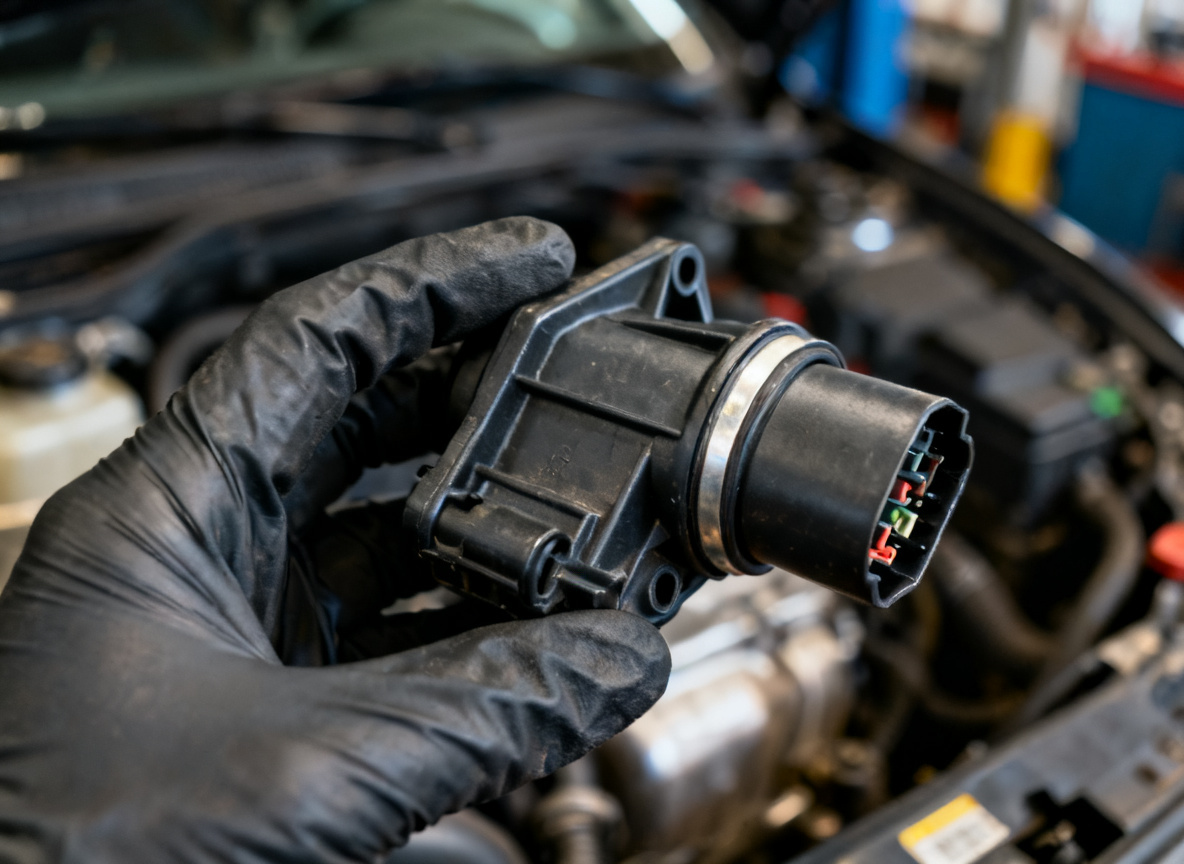
Diesel Mass Airflow Sensor Fault: Symptoms, Causes & What to Do
Rough running, limp mode, poor fuel economy, or an EML that won’t clear — a faulty mass airflow sensor causes all of these, and it’s regularly misdiagnosed or replaced unnecessarily. This guide explains how the MAF sensor works, what it looks like when it fails, and why proper diagnosis matters before reaching for a replacement part.
In This Guide
- What the mass airflow sensor actually does
- Symptoms of a faulty MAF sensor on diesel
- Common causes of MAF sensor failure
- MAF sensor fault codes: what they mean
- Why cleaning isn’t always the answer
- How MAF sensor faults are properly diagnosed
- MAF sensors and ECU remaps
- FAQs
What the Mass Airflow Sensor Actually Does
The mass airflow (MAF) sensor sits in the air intake tract, usually between the air filter housing and the turbocharger inlet. Its job is to measure the precise mass of air entering the engine at any given moment.
This measurement is critical. The ECU uses it to calculate how much fuel to inject for complete, efficient combustion. If the MAF is reporting the wrong airflow figure, the fuel calculation is wrong — leading to a rich or lean mixture, poor combustion, increased emissions, and in many cases a protection response from the ECU such as limp mode.
Most modern MAF sensors use a hot-wire element — a fine wire heated to a set temperature. As air flows past, it cools the wire. The sensor measures how much current is needed to maintain the wire temperature, and from that derives the airflow mass. It’s accurate, fast-responding, and directly linked to the engine’s fundamental fuelling decisions every time the accelerator moves.
MAF vs MAP: Some diesel engines use a MAP (manifold absolute pressure) sensor instead of or alongside a MAF. These are separate components with different roles. A fault in one doesn’t automatically implicate the other — accurate diagnosis requires reading the correct sensor’s data.
Symptoms of a Faulty MAF Sensor on Diesel
MAF faults are often gradual — the sensor drifts out of accuracy rather than failing completely. This makes the symptoms easy to attribute to other causes, particularly on higher-mileage vehicles where multiple minor issues exist simultaneously.
Rough Running or Uneven Power Delivery
An inaccurate MAF reading means the fuelling calculation is off. The result is uneven combustion — the engine may run smoothly at light throttle but feel hesitant or rough when demand increases. Some drivers describe it as a stumble or hesitation when pulling away, or a flat spot mid-range where the engine used to pull cleanly.
Poor Fuel Economy
If the MAF is under-reading airflow, the ECU compensates by injecting more fuel to maintain a target air-to-fuel ratio. Fuel consumption rises noticeably — often gradually enough that it isn’t spotted until the driver adds up several months of fill-ups. A MAF that over-reads has the opposite effect: the ECU injects less fuel than the engine needs, leading to lean running and the symptoms that follow.
Engine Management Light (EML)
Most MAF faults will trigger the EML. The ECU monitors the plausibility of the MAF reading against other sensors — boost pressure, throttle position, engine speed — and logs a fault when the figures don’t add up. The EML may come on intermittently at first before becoming permanent as the fault worsens.
Limp Mode
When the ECU detects that MAF data has deviated significantly from what it expects, it may activate reduced power mode to prevent the engine running excessively lean or rich. Limp mode triggered by a MAF fault typically feels similar to boost-related limp mode: flat throttle response, capped revs, and a general reluctance to accelerate under load.
Black Smoke Under Acceleration
A MAF that under-reads leads to over-fuelling — the ECU injects more diesel than the airflow can support clean combustion for. The result is black smoke from the exhaust, particularly under hard acceleration. On a diesel this is a recognisable sign that combustion is running rich, and a MAF fault is one of the more common causes.
Difficult Cold Starts
The MAF reading is used during the starting phase to calibrate injector timing and fuelling. A faulty MAF can cause the engine to crank longer than usual before firing in cold conditions, and may result in rough running for the first few seconds after a cold start.
Failed or Failing DPF
A MAF fault that causes rich running significantly accelerates DPF loading. More unburned particulates pass through an over-fuelled engine, and active DPF regeneration becomes less effective when combustion quality is poor. If your DPF is blocking more frequently and you have an unresolved EML, the MAF is worth investigating as a contributing factor.
Common Causes of MAF Sensor Failure
MAF sensors fail for a small number of well-understood reasons. Knowing the cause matters because it affects whether cleaning, replacement, or a different repair is the right response.
Contamination
The most common cause on high-mileage vehicles. Oil vapour from a poorly functioning crankcase ventilation system (or an engine burning oil) coats the hot-wire element with a film that insulates it, reducing sensitivity. Engine fumes, dust that bypasses a damaged air filter, and spray from engine cleaning can all contaminate the sensing element.
Sensor Element Degradation
Over time and with mileage, the hot-wire element drifts out of calibration. The sensor still functions and produces readings, but they’re no longer accurate. This is hard to detect with a basic fault code scan — the code may not be present because the reading is plausible, just wrong. Live data comparison against calculated airflow values is needed to catch it.
Physical Damage
Insects, debris, or foreign objects pulled through a damaged air filter can physically damage the sensing element. Less common than contamination, but usually results in an immediate and total failure rather than a gradual drift.
Wiring or Connector Issues
Intermittent MAF faults that come and go are often wiring-related rather than sensor failures. A corroded connector, chafed wire, or broken pin can give exactly the same fault codes as a failed MAF sensor. Replacing the sensor without checking the wiring loom leaves the real problem in place.
MAF Sensor Fault Codes: What They Mean
The most common MAF-related fault codes on diesel vehicles are:
| Fault Code | Description | What It Suggests |
|---|---|---|
| P0100 | MAF circuit malfunction | Signal is completely absent or erratic — usually wiring or a failed sensor |
| P0101 | MAF circuit range/performance | Signal is present but outside expected parameters — often contamination or sensor drift |
| P0102 | MAF circuit low input | Signal is lower than expected — possible contamination, broken element, or short to ground |
| P0103 | MAF circuit high input | Signal is higher than expected — possible short to voltage or faulty sensor |
| P0104 | MAF circuit intermittent | Fault comes and goes — strong indicator of a wiring or connector issue |
These codes identify that there’s a problem in the MAF circuit — they don’t tell you whether to clean it, replace it, or fix the wiring. That step requires live data analysis and physical inspection.
Why Cleaning Isn’t Always the Answer
MAF sensor cleaning sprays are widely available, and cleaning is sometimes a legitimate first step — particularly on sensors contaminated by oil vapour where the element is physically intact and the coating is relatively light. In these cases, careful cleaning can restore normal operation.
However, cleaning doesn’t work when the element has drifted out of calibration due to age, when the wiring is the fault, or when the contamination is too severe to remove without damaging the element. Cleaning a sensor that has failed internally will show no improvement in live data readings.
The practical approach is to confirm via live data whether the sensor reading is plausible after cleaning — not just whether the fault code has cleared. A cleared code with an inaccurate live reading means the underlying problem is still present and will return.
How MAF Sensor Faults Are Properly Diagnosed
A proper MAF sensor diagnosis goes beyond reading fault codes. Here’s what the process should cover:
- Fault code retrieval and code history: Note whether codes are current, stored, or intermittent. Intermittent codes alongside P0104 point strongly to a wiring issue.
- Live MAF data against calculated airflow: Compare the MAF reading with what the ECU calculates the airflow should be based on engine speed, boost pressure, and throttle position. Significant deviation identifies sensor inaccuracy even when no fault code is present.
- Wiring harness inspection: Check the MAF connector for corrosion, damaged pins, and secure seating. Inspect the loom for chafing near brackets or heat sources.
- Air filter and induction system check: A clogged or damaged air filter can affect the airflow reading as much as a failed sensor. Check the filter and confirm the induction system is sealed correctly upstream of the MAF.
- Crankcase ventilation check: If oil contamination is found on the MAF element, the source needs to be identified. A poorly functioning PCV system will contaminate a replacement sensor just as quickly as the original.
MAF Sensors and ECU Remaps
An ECU remap recalibrates the fuelling, boost, and injection timing maps — all of which rely on accurate MAF data as an input. If the MAF is reading incorrectly on a remapped vehicle, the custom map’s fuel delivery calculations are based on wrong data from the start.
This means a MAF fault on a remapped vehicle can affect performance more noticeably than on an unmodified engine — the expected performance from the remap won’t materialise if airflow data is unreliable. Conversely, any vehicle with a confirmed clean MAF sensor and a healthy engine may benefit from exploring ECU remapping at Stoke Tuning to realise the engine’s real performance potential.
If you’ve had a remap fitted and performance has noticeably dropped since, a MAF sensor check is a logical early diagnostic step before assuming the map needs adjustment.
Diesel Running Rough or EML Won’t Clear?
Advanced diagnostics at Stoke Tuning identifies MAF sensor faults with live data — not just fault codes. Book a diagnostic session and get a clear answer on what’s actually wrong before spending on parts.
FAQs: Mass Airflow Sensor Fault on Diesel
Can I drive with a faulty MAF sensor?
You can in most cases, but it isn’t advisable long term. A faulty MAF causes incorrect fuelling, which accelerates DPF loading, increases fuel consumption, and on some engines contributes to injector wear from poor combustion quality. If the vehicle is in limp mode, driving distances should be limited to what’s necessary to reach a workshop.
Will disconnecting the MAF sensor tell me if it’s faulty?
Some vehicles do run differently with the MAF unplugged — the ECU falls back to a fixed fuelling table without the sensor. If performance improves noticeably with the sensor disconnected, it’s a reasonable indicator the MAF is reading incorrectly. However, this isn’t a definitive test and shouldn’t be used as a long-term solution.
How much does a MAF sensor replacement cost?
MAF sensor costs vary significantly by vehicle make and model. Some sensors are inexpensive; others on premium European vehicles can be considerably more. Labour is usually straightforward as the sensor is accessible. Contact Stoke Tuning for a quote specific to your vehicle — and confirm the diagnosis first, as replacement without diagnosis has a poor track record.
I replaced the MAF sensor but the fault code returned — why?
The most common reason is that the fault was in the wiring, not the sensor itself. A connector or loom issue will return identical codes regardless of how many sensors are fitted. The second most common reason is oil contamination from a crankcase ventilation fault — the new sensor gets contaminated as quickly as the old one. Proper diagnosis before replacement prevents both scenarios.
Can a MAF sensor fault cause DPF problems?
Yes. Over-fuelling caused by a MAF sensor that under-reads airflow increases particulate output and deposits more soot in the DPF than normal driving would. Active DPF regeneration also becomes less efficient when combustion quality is poor. Resolving the MAF fault is usually a necessary step before DPF regeneration can work correctly again.
Related reading: Diesel Glow Plug Fault: Symptoms, Causes, and What to Do About It.