Stoke Tuning & Adblue Repair — Stoke-on-Trent, Staffordshire
NOx Sensor Fault: Symptoms, Causes and What Diesel Drivers Should Do Next
Understand what your NOx sensor is telling you — before your diesel goes into limp mode
Diagnostics & Fault Guide
If your diesel has started behaving strangely — triggering warning lights, losing power, or cycling in and out of limp mode — a NOx sensor fault could be behind it. These sensors are responsible for monitoring nitrogen oxide emissions in modern diesel engines, and when they fail or send incorrect readings, your vehicle’s engine management system reacts fast.
The problem is that NOx sensor faults don’t always announce themselves clearly. The symptoms can look like a dozen other diesel issues, which means drivers often waste money on the wrong repairs before the real cause is identified.
This guide explains exactly what a NOx sensor fault looks like, why it happens, and what your realistic options are once the fault is confirmed.
What a NOx Sensor Actually Does
A NOx (nitrogen oxide) sensor sits in your exhaust system and monitors the level of NOx gases leaving the engine. Modern diesel engines use two sensors — one upstream and one downstream of the Selective Catalytic Reduction (SCR) system — to verify that the AdBlue dosing process is working as it should.
The data these sensors report goes directly to the engine control unit (ECU). If the readings fall outside expected parameters, the ECU assumes either the emissions system has failed or the sensor itself is faulty. Either way, the result is the same: a fault code is logged, a warning light comes on, and the engine may be limited in power or revs.
Because the sensor is part of your vehicle’s emissions compliance system, the ECU is designed to respond aggressively when something looks wrong. That’s why NOx sensor faults so often trigger limp mode or repeated warning messages.
Symptoms of a NOx Sensor Fault
The symptoms of a NOx sensor fault can be easy to mistake for other diesel problems. Here’s what to watch out for:
Engine Warning Light
The most common first indicator is the engine management light (EML). On its own, this tells you very little — it could be hundreds of things. But paired with any of the other symptoms below, it points strongly toward an emissions-related fault, including the NOx sensor.
Reduced Power or Limp Mode
When the ECU registers a NOx sensor fault, it will often trigger a power reduction or limp mode as a protective measure. You’ll notice the engine feels flat, acceleration is restricted, and top speed may be capped. This is the vehicle protecting itself and complying with emissions standards — not a mechanical failure in itself, but a serious signal that something needs attention.
AdBlue System Warnings
Because the NOx sensor is closely tied to the SCR system and AdBlue dosing, a faulty sensor can trigger AdBlue-related warnings even when your fluid level is fine. The system may flag a dosing fault, a catalyst efficiency fault, or an SCR system malfunction. If you’re seeing these messages and your AdBlue tank is not low, the sensor is worth investigating.
Regeneration Cycles Not Completing
A NOx sensor fault can disrupt passive and active DPF regeneration cycles. If your diesel is producing unusual exhaust smells, seems to be using more fuel than usual, or is showing DPF-related warnings alongside the NOx issue, it’s likely that the two systems are affecting each other.
Repeated Fault Codes After Clearing
One of the most reliable indicators of a genuine NOx sensor problem is that the fault returns quickly after being cleared. If a garage clears the code and it reappears within a few drive cycles, the sensor itself (or the wiring to it) is almost certainly the source.
Quick Summary: Key NOx Sensor Fault Symptoms
- Engine management or emissions warning light
- Limp mode or sudden power restriction
- AdBlue or SCR system fault messages (with adequate fluid)
- DPF-related warnings appearing alongside
- Fault codes returning quickly after being cleared
- Increased fuel consumption or unusual exhaust smell
Common Causes of NOx Sensor Failure
NOx sensors don’t fail randomly. There are usually identifiable reasons why they start sending incorrect readings or stop working altogether.
Sensor Age and Contamination
NOx sensors are exposed to extreme heat and exhaust gases throughout their working life. Over time, the sensing element can become contaminated by soot, oil residue, or AdBlue crystal deposits. This contamination causes the sensor to send inaccurate readings rather than failing completely, which can make the fault harder to diagnose.
Wiring and Connector Problems
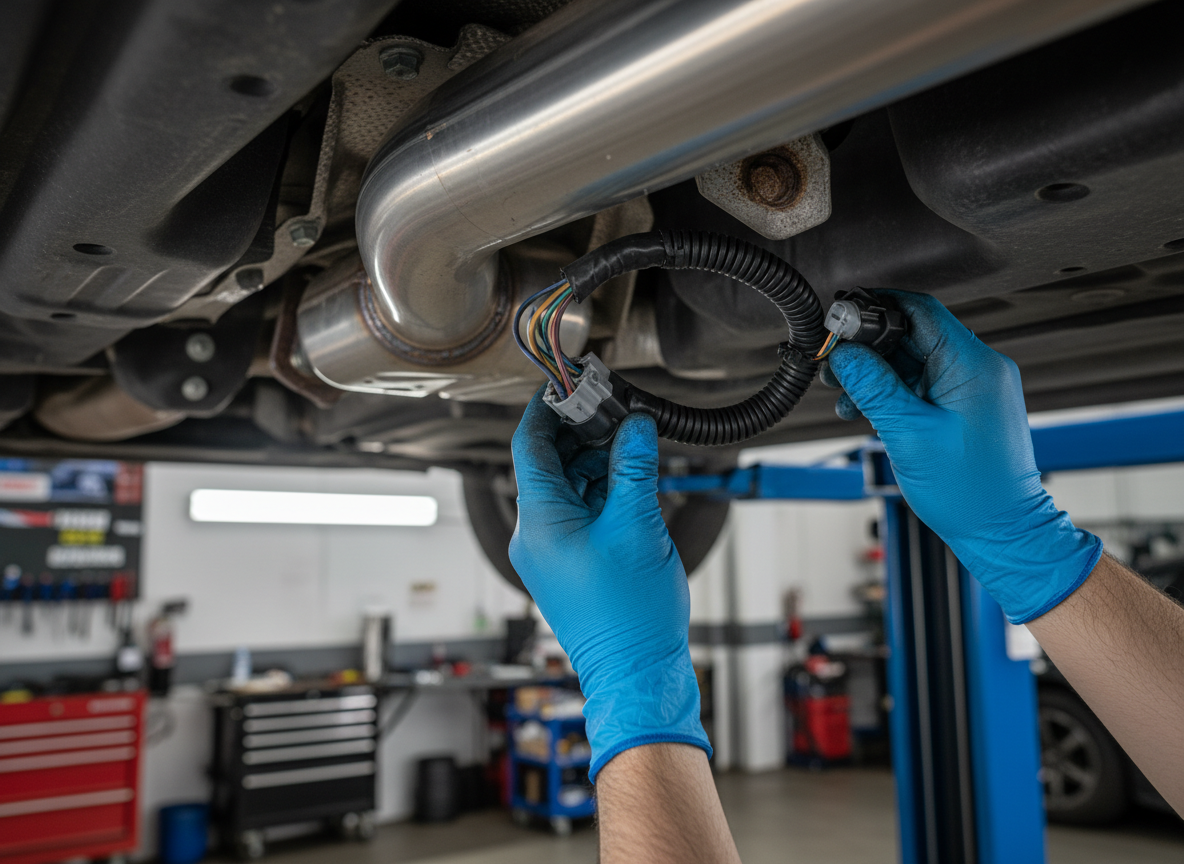
The wiring harness running to the NOx sensor is exposed to heat, vibration, and road debris. Chafed wiring, corroded connectors, or a broken pin in the sensor plug will disrupt the signal between the sensor and the ECU — and this looks exactly the same as a sensor failure in the fault data.
AdBlue System Issues
If the AdBlue dosing system is not working properly — whether because of a pump fault, injector blockage, or fluid quality problem — the downstream NOx sensor will see abnormal readings. In this situation, the sensor itself may be perfectly fine, but the fault data points at it because it’s reporting what the SCR system is actually doing (or failing to do).
SCR Catalyst Failure
A failing or degraded SCR catalyst affects the efficiency of NOx conversion. The sensor downstream of the catalyst measures this conversion efficiency, so a degraded catalyst can cause the sensor readings to look as if there’s a sensor fault when the actual problem is the catalyst itself.
Genuine Sensor Failure
Sometimes the sensor simply fails. Bosch and other OEM sensor suppliers have acknowledged failure patterns in certain NOx sensor types. If you’re driving a diesel built between 2012 and 2020, sensor failure is a genuine possibility, particularly at higher mileage.
Warning Lights and Fault Codes
Most NOx sensor faults will log one or more of the following codes in your ECU:
| Fault Code | Description |
|---|---|
| P2200 / P2201 | NOx sensor circuit malfunction (bank 1 or 2) |
| P2202 / P2203 | NOx sensor circuit low/high input |
| P2204 / P2205 | NOx sensor slow response (bank 1 or 2) |
| P229E / P229F | SCR NOx catalyst efficiency below threshold |
| P13DF / P204F | NOx conversion efficiency issues (common in Mercedes) |
Note that the fault code alone doesn’t always pinpoint the exact component at fault. A trained technician with OEM-level diagnostics can use live data alongside the code to determine whether the problem is the sensor, the wiring, the dosing system, or the catalyst.
Getting a Proper Diagnosis
Generic code readers will tell you a NOx-related fault is present, but they won’t tell you why. A proper diagnosis should include:
- Live data monitoring — checking sensor readings in real-time as the engine is running, not just the stored code
- Wiring and connector inspection — physical inspection of the sensor harness, connector pins, and ground paths
- AdBlue system check — verifying that the dosing pump, injector, and fluid quality are not the underlying cause
- SCR catalyst assessment — checking whether the catalyst itself is still performing within range
- Freeze frame data — reviewing the conditions under which the fault was first recorded
Replacing the NOx sensor without doing this work first is a common and expensive mistake. In many cases, the sensor is not the primary cause — and fitting a new one will not resolve the underlying fault.
At Stoke Tuning, we offer advanced diagnostics that goes well beyond code reading. We work with OEM-level diagnostic tools to properly isolate NOx sensor faults before recommending any parts or solutions.
Your Options Once the Fault Is Confirmed
Once a genuine NOx sensor problem has been confirmed — or a fault in the associated system — you have a few options depending on your vehicle, use case, and priorities.
Sensor Replacement
If the sensor itself has failed, replacing it is the standard first step. OEM sensors are preferable where possible, as pattern parts have a variable success rate with some ECU systems. This is the right approach where the fault is clearly sensor-related and the rest of the SCR system is functioning correctly.
NOx Sensor Delete (Off-Road / Export Use)
For vehicles that are used off-road or for export, a NOx sensor delete involves remapping the ECU to remove the sensor monitoring function. This eliminates the fault loop and prevents limp mode — but it is only appropriate for vehicles not being used on UK public roads.
NOx Sensor Bypass
A NOx sensor bypass involves using an emulator device that sends a false signal to the ECU in place of the sensor. This approach carries risks around reliability and is less stable than an ECU delete solution.
Important Note on Legal Use
NOx sensor delete solutions are intended for off-road or export use only. Using a vehicle with a deleted emissions system on UK public roads may affect roadworthiness and insurance compliance. Stoke Tuning will always discuss your specific situation before recommending any solution.
Getting Fault Codes You Can’t Resolve?
Stoke Tuning offers proper NOx and emissions diagnostics in Stoke-on-Trent. We identify the actual fault before recommending any fix — no guesswork, no unnecessary parts.
Conclusion
A NOx sensor fault is one of the more frustrating diesel problems precisely because its symptoms overlap with so many other issues. Limp mode, AdBlue warnings, repeated fault codes — they all appear with other diesel faults too. The key is getting a proper diagnosis that goes beyond reading the code and actually confirms what’s causing the sensor to fail or behave incorrectly.
If your diesel has been flagging NOx-related warnings, or if you’ve already had the sensor replaced and the fault keeps returning, the underlying system needs a closer look. We’re based in Stoke-on-Trent and work with diesel vehicles from across Staffordshire and beyond.
Frequently Asked Questions
Can I drive with a NOx sensor fault?
You can often drive short distances, but a NOx fault will usually trigger limp mode or repeat warning lights. Continuing to drive without diagnosis risks making the underlying problem worse and can affect other parts of the emissions system.
How much does a NOx sensor replacement cost in the UK?
OEM NOx sensors typically cost between £80 and £300 depending on the vehicle, plus labour. However, fitting a replacement sensor without a proper diagnosis first is often money wasted — always confirm that the sensor itself is the cause before ordering parts.
Will a NOx sensor fault cause my vehicle to fail an MOT?
A NOx sensor fault that triggers an engine management light will cause an MOT failure. Emissions system faults are taken seriously at MOT level, so the fault needs to be resolved before presenting the vehicle for test.
Is a NOx sensor delete legal in the UK?
NOx sensor delete is only appropriate for vehicles used off-road or for export. Using a vehicle with a deleted emissions system on UK public roads is not permitted. Speak to us about your specific situation before making any decisions.
My NOx sensor was replaced but the fault came back. Why?
This is common when the sensor replacement is carried out without a full system diagnosis. The fault often lies with the AdBlue dosing system, SCR catalyst, or wiring — not the sensor itself. A proper root-cause diagnosis is needed to prevent repeat failures.