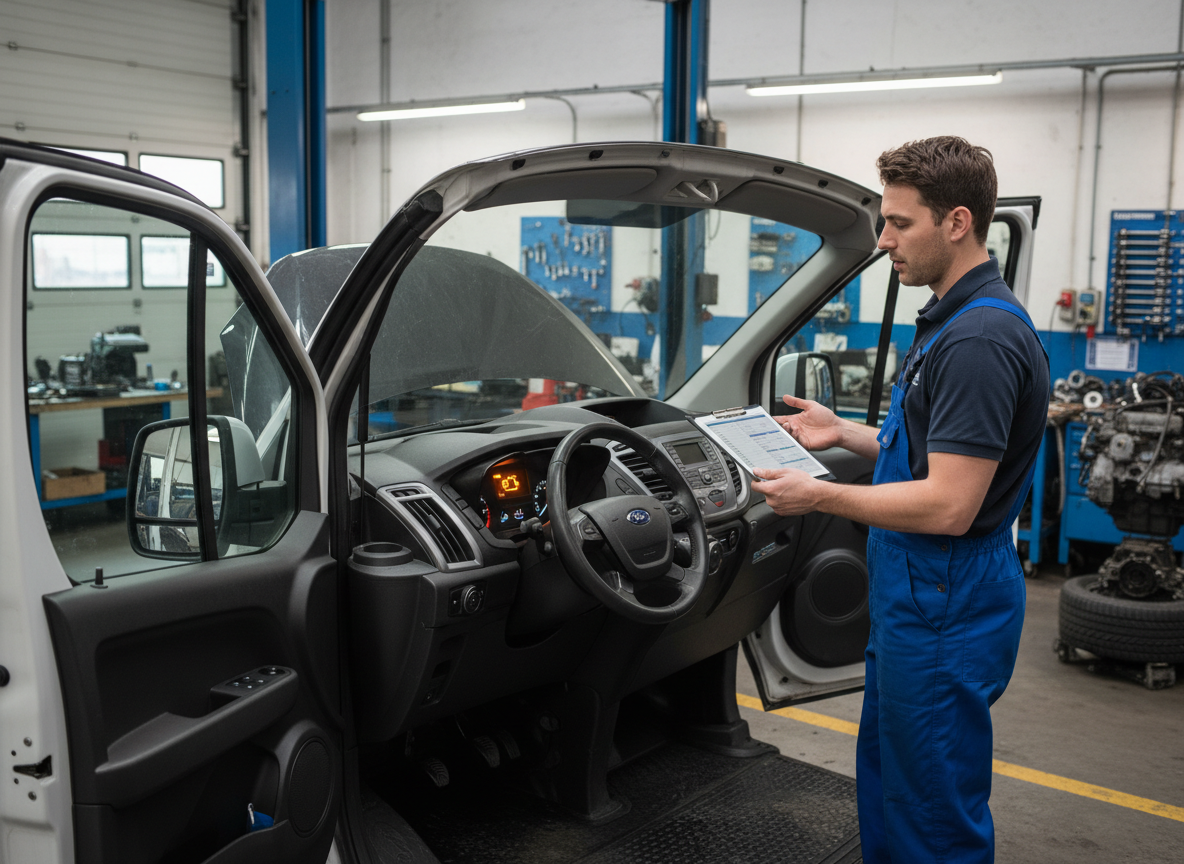
SID212EVO Limp Mode: Full Diagnostic Checklist for EcoBlue Vans
EcoBlue limp mode is not one fault. It is a response.
SID212EVO can cut torque for SCR problems, boost issues, EGR faults, DPF trouble, or sensor plausibility.
This checklist helps you test in the right order so you stop chasing the wrong system.
For a full overview of SID212EVO fault patterns, see our
complete SID212EVO fault guide
.
What Makes SID212EVO Limp Mode Different
With SID212EVO, the ECU uses a torque model. When it sees a fault that risks emissions compliance or engine safety,
it limits torque request, changes boost targets, and can disable certain strategies.
The tricky bit is overlap.
SCR faults can look like boost faults.
DPF issues can make EGR look worse.
Short runs can stop every system reaching stable conditions.
SID212EVO no-start countdown won’t reset after repairs.
Before You Plug Anything In
These three checks prevent wasted hours.
1) Confirm the pattern
- Does limp mode happen cold, hot, or both?
- Does it trigger under load, cruise, or idle?
- Does it reset after key-off?
Pattern tells you whether to suspect temperature thresholds, load thresholds, or comms faults.
2) Check battery and charging
- Battery condition under load
- Charging stability
- Ground points condition
Low voltage creates false flags and breaks routines.
3) Ask what was already replaced
- NOx sensors replaced?
- AdBlue pump replaced?
- EGR/boost sensors swapped?
Parts history helps spot misdiagnosis and missing adaptation steps.
SID212EVO Limp Mode Diagnostic Order
This order works because it starts with “proof signals” and branches based on data.
It stops you jumping straight to parts.
| Step | What you check | What “good” looks like | What “bad” suggests |
|---|---|---|---|
| Step 1 | Read faults and freeze-frame. Note when limp mode triggered. |
Fault story matches driver pattern. | A historic code gets blamed for a new symptom. Data mismatch signals misdirection. |
| Step 2 | Log live data at idle, then under load. Focus on torque request, boost target vs actual, EGT, and rail pressure. |
Targets and actual values track each other. No sudden clamp in torque request. |
ECU clamps torque despite “normal” boost. Often points to emissions strategy rather than turbo failure. |
| Step 3 | Separate SCR limp from boost limp. Watch SCR-related signals during warm-up and dosing windows. |
Stable dosing behaviour when conditions allow. NOx values change plausibly. |
Plausibility failures, poor dosing response, or unstable pressure can force torque reduction. |
| Step 4 | Check DPF status and regen history. Look for frequent regens, high soot load, or aborted cycles. |
Reasonable soot load and completed regen cycles. | DPF restriction can cause limp mode and also distort EGR and boost readings. |
| Step 5 | Verify electrical health on suspect circuits under load. Do not rely on a static continuity check. |
Stable supply voltage and clean signals under vibration and heat. | Voltage drop, corrosion, or CAN issues can create repeat “parts” faults. |
| Step 6 | Run the right routines after repairs. Confirm adaptations complete and status holds after a road test. |
Clear “pass” events and stable status after a full drive cycle. | Limp returns because the ECU never accepted the repair baseline. |
If your limp mode involves SCR pressure behaviour, pair this with:
SID212EVO AdBlue pressure readings: what’s normal.
Quick Branching Guide
Use these “if you see this, do that” rules during a live session.
If torque request drops hard
- Check which system status changed at the same moment
- Check whether boost target also dropped, or stayed high
- Check if SCR dosing window started, or ended
A “boost” complaint can be an SCR strategy pulling torque.
If boost target stays high but actual drops
- Check intake leaks and boost control
- Check MAP/MAF plausibility
- Confirm EGR position behaviour
If you suspect sensor plausibility, see:
MAF/MAP sensor failure.
If limp mode appears mostly in winter
- Check heater thresholds and warm-up behaviour
- Watch for crystallisation patterns
- Confirm voltage stability on cold starts
Dedicated winter piece comes later in this cluster:
SID212EVO AdBlue heater faults in cold weather.
If limp happens after repeated short runs
- Check DPF regen history and soot load
- Check EGR deposits and air flow issues
- Check SCR completion events after warm-up
Related reading:
engine carbon build-up from short journeys,
early DPF warnings.
Why Code-Only Limp Mode “Fixes” Fail
Clearing codes can restore power for a short time. It does not prove the system recovered.
The ECU will re-check, then pull torque again if it sees the same condition.
If you keep getting told “it’s the pump” or “it’s the NOx sensor” without live testing,
read this:
OBD code reader limitations.
SCR system explained and
winter AdBlue problems.
When DPF Trouble Drives the Whole Story
We see EcoBlue vans in limp mode where SCR warnings get all the attention, but the real limiter is DPF restriction.
A blocked DPF raises backpressure. That shifts boost behaviour and EGR flow. It can also stop stable exhaust temperatures.
Common DPF clues
- Frequent fan running after shutdown
- Regens that keep aborting
- Poor mpg and rising oil level
Book a SID212EVO Limp Mode Diagnostic
Tell us:
what the dash says, when limp mode happens, and what has already been replaced.
We’ll run a live session, follow the checklist, and give you a clear plan.
If you manage multiple vans and downtime is the big cost, keep an eye out for our fleet-focused post later in this cluster.